TV viewing distance calculator
Enter your viewing distance and see which TV sizes suit it and how they look in 3D from your couch.
Enter viewing distance
Measured from your eyes in the seated position to the screen.
10.0 ft away: 55 to 85 inches
A living room in 3D, with a door, a power outlet and a mug for scale. Pick a size and see how big it looks at your distance.
How the sizes look at 10.0 ft
How to measure viewing distance?
Measure the distance from your eyes in your seated position (sofa, armchair) to the screen, i.e. to the wall where the TV will hang, minus the mount and TV depth.
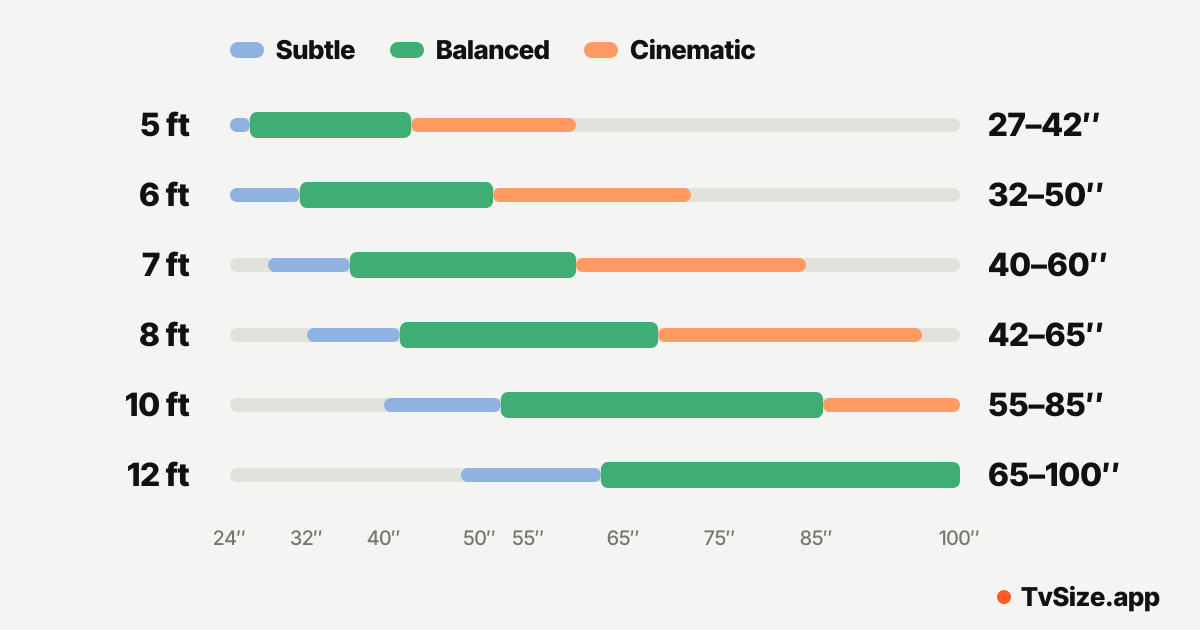
TV size by viewing distance: chart
What size TV for 6, 8 or 10 feet away? For common viewing distances, the chart shows which sizes look balanced, which subtle and which cinematic.
| Distance | Subtle2.3–3 × | Balanced1.4–2.3 × | Cinematic1–1.4 × |
|---|---|---|---|
| 5 ft5 ft away | 24″ | 27–42″ | 43–60″ |
| 6 ft6 ft away | 24–27″ | 32–50″ | 55–70″ |
| 7 ft7 ft away | 32″ | 40–60″ | 65–83″ |
| 8 ft8 ft away | 32–40″ | 42–65″ | 70–90″ |
| 9 ft9 ft away | 40–45″ | 48–77″ | 80–100″ |
| 10 ft10 ft away | 40–50″ | 55–85″ | 86–100″ |
| 12 ft12 ft away | 48–60″ | 65–100″ | > 100″ |
| 14 ft14 ft away | 58–70″ | 75–100″ | > 100″ |
For 4K TVs. Balanced: distance = 1.4 to 2.3 × diagonal (about 35° to 21° viewing angle). Cinematic: 1 to 1.4 × (around the THX value of 1.2 ×). Subtle: 2.3 to 3 × (around Stiftung Warentest’s 2.5 ×).
How we calculate
From about 1.2 × the screen diagonal on, sharpness is no longer a factor with 4K. Normal eyes stop seeing individual pixels from 0.8 × (ITU-R BT.500-15). According to lab measurements by the University of Cambridge (2025), the eye’s limit is 94 pixels per degree on average, which for 4K corresponds to about 1.2 ×. What is left is how large you want the picture to look, and that is taste. So we give ranges instead of a single number.
The three styles
- Subtle: 2.3 to 3 × the diagonal (about 21° to 17° viewing angle), around the 2.5 × that the German consumer organization Stiftung Warentest recommends to couples as a compromise after its 2026 user test: 25 people chose their preferred distance from 43-, 55- and 65-inch 4K TVs, men 2 × on average, women 2.4 to 2.7 ×.
- Balanced: 1.4 to 2.3 × the diagonal (about 35° to 21°), the range we lead with. The far end is the average of all 25 Stiftung Warentest participants, which we calculated from the published values for men and women (about 2.2 to 2.3 ×). Stiftung Warentest’s 2.5 ×, by contrast, is its compromise for couples (men chose 2 ×, women 2.4 to 2.7 ×), so it falls in “Subtle” for us. The near end lies between the THX value (1.2 ×, about 40°) and the often quoted 30°, where the picture already looks big but not yet like a cinema. Rule of thumb: diagonal = viewing distance ÷ 2.3 to ÷ 1.4.
- Cinematic: 1 to 1.4 × the diagonal (about 47° to 35°), around the THX value: distance = diagonal ÷ 0.835, i.e. about 1.2 ×, which corresponds to about a 40° viewing angle.
Example 65 inches (165 cm diagonal): cinematic at 5.5–7.5 ft, balanced at 7.6–12.4 ft, subtle at 12.5–16.2 ft.
Why retailers often name bigger TVs
Some retailers and manufacturers quote 1.2 × the diagonal. That is the THX value for a cinema experience, a technical target for maximum impact. Others work from the distance at which you stop seeing pixels (about 1.6 × with Full HD). Where people were allowed to choose their own distance, the result was more: 2 to 2.7 × at Stiftung Warentest. The French consumer magazine Que Choisir also gives 2.3 meters for 40 inches, about 2.3 ×. So our “Balanced” range runs from 1.4 × to 2.3 ×, and we show the cinema value as its own style.
Very close and very far
Below 1 × the diagonal (more than about 47° viewing angle) the picture is so wide that your eyes wander across it; that is normal at a desk and unusual on a couch. Beyond 3 × (less than about 17°) the picture looks rather small: that is about 6 picture heights, the reference distance SD television was designed for (ITU-R BT.500-15). We only describe both, there is no fixed limit.
4K or Full HD?
With Full HD, pixels disappear for normal eyes from about 1.6 × the diagonal, with 4K already from 0.8 × (ITU-R BT.500-15). In most of the “Balanced” range both look practically equally sharp to normal eyes; at its near end (1.4 to 1.6 ×) and for “Cinematic”, 4K is worth it. Under ideal conditions it is different: converting the lab measurements by the University of Cambridge (2025), a difference with Full HD can still be seen on average up to about 2.4 ×, and further for especially sharp eyes. Most TVs from 43 inches up have 4K today anyway.
The evidence is thin: Stiftung Warentest’s test group was small (25 people), how widely preferences vary was not published, and nobody has measured how satisfied people are years after buying. Only 43- to 65-inch TVs were tested; for very small and very large TVs we carry the factors over. That is why we give ranges instead of a single size. The surest way to decide is a photo of your wall.
Viewing distance FAQ
What size TV for 6 ft viewing distance?
At 6 ft away, TVs from 32 to 50 inches fit, and the picture looks balanced. It looks cinematic with TVs from 55 to 70 inches. It looks more subtle with TVs from 24 to 27 inches. Rule of thumb for 4K: screen diagonal = viewing distance ÷ 2.3 to ÷ 1.4 (balanced). Bigger looks cinematic, smaller subtle.
What size TV for 8 ft viewing distance?
At 8 ft away, TVs from 42 to 65 inches fit, and the picture looks balanced. It looks cinematic with TVs from 70 to 90 inches. It looks more subtle with TVs from 32 to 40 inches. Rule of thumb for 4K: screen diagonal = viewing distance ÷ 2.3 to ÷ 1.4 (balanced). Bigger looks cinematic, smaller subtle.
What size TV for 10 ft viewing distance?
At 10 ft away, TVs from 55 to 85 inches fit, and the picture looks balanced. It looks cinematic with TVs from 86 to 100 inches. It looks more subtle with TVs from 40 to 50 inches. Rule of thumb for 4K: screen diagonal = viewing distance ÷ 2.3 to ÷ 1.4 (balanced). Bigger looks cinematic, smaller subtle.
What size TV for 12 ft viewing distance?
At 12 ft away, TVs from 65 to 100 inches fit, and the picture looks balanced. For a cinematic picture even a 100-inch TV is not enough; consider a projector. It looks more subtle with TVs from 48 to 60 inches. Rule of thumb for 4K: screen diagonal = viewing distance ÷ 2.3 to ÷ 1.4 (balanced). Bigger looks cinematic, smaller subtle.
What is the ideal distance from a TV?
There is no single ideal distance; it depends on how large you want the picture to look. The picture looks balanced from 1.4 to 2.3 times the screen diagonal, so from 7.6–12.4 ft for a 65-inch TV. It looks cinematic closer in (5.5–7.5 ft, around the THX value of 1.2 ×) and more subtle farther back (12.5–16.2 ft, around Stiftung Warentest’s 2.5 ×). If you sit closer than about the screen diagonal, the picture is so wide that your eyes wander across it.
How far should the couch be from the TV?
Measure from your eyes in the seated position to the screen, not from the front of the couch to the wall. In most living rooms that is 7 ft to 11 ft, where, depending on the distance, 40-inch to 90-inch TVs look balanced. The center of the screen should be at roughly eye level.
Does the viewing distance also apply to 1080p TVs?
Yes. With Full HD (1080p), pixels disappear for normal eyes from about 1.6 times the screen diagonal (ITU-R BT.500-15), so from about 8.7 ft for a 65-inch TV. A 65-inch TV looks balanced from 7.6–12.4 ft; except at its near end, Full HD therefore looks practically as sharp as 4K to normal eyes. If you sit closer, for a cinematic picture for example, you see the benefit of 4K. Under ideal conditions it is different: in the lab at the University of Cambridge (2025), participants could still see a difference on average up to about 2.4 × (converted), and very sharp eyes even farther.
Is sitting too close to the TV bad for your eyes?
It does not damage your eyes, but it can cause eyestrain (American Academy of Ophthalmology). Looking at a screen for a long time also tends to make you blink less, which can lead to dry, tired eyes. With some distance, some room light and the occasional break, you can watch comfortably for hours.
Try TV sizes on your wall
With a photo of your wall you see every size to scale, free and without signing up.
Try sizes on your wall