TV Sizes
TV sizes run from 24 to 100 inches, measured diagonally across the picture. The most common are 43, 50, 55, 65 and 75 inches.
- The right size depends on your viewing distance: at 8 ft, 42–65″ look balanced.
- Like it cinematic? Then go bigger: 70–90″ at the same distance. If you prefer it subtle, a smaller size is fine.
- Each step up is bigger than the number suggests: a 65″ picture has about 40% more area than a 55″.
TV sizes in cm and inches
Every size to scale, stacked. Screen dimensions without bezel, viewing distance for a balanced picture: 1.4 to 2.3 times the diagonal.
| Size | Diagonal | Width × height | Viewing distance | View details |
|---|---|---|---|---|
| 24 inches | 61 cm | 21 × 12″ | 2.8–4.6 ft | View details |
| 27 inches | 68.6 cm | 24 × 13″ | 3.2–5.1 ft | View details |
| 32 inches | 81.3 cm | 28 × 16″ | 3.8–6.1 ft | View details |
| 40 inches | 101.6 cm | 35 × 20″ | 4.7–7.6 ft | View details |
| 42 inches | 106.7 cm | 37 × 21″ | 4.9–8.0 ft | View details |
| 43 inches | 109.2 cm | 37 × 21″ | 5.1–8.2 ft | View details |
| 45 inches | 114.3 cm | 39 × 22″ | 5.3–8.6 ft | View details |
| 48 inches | 121.9 cm | 42 × 24″ | 5.6–9.2 ft | View details |
| 49 inches | 124.5 cm | 43 × 24″ | 5.8–9.3 ft | View details |
| 50 inches | 127 cm | 44 × 25″ | 5.9–9.5 ft | View details |
| 55 inches | 139.7 cm | 48 × 27″ | 6.5–10.5 ft | View details |
| 58 inches | 147.3 cm | 51 × 28″ | 6.8–11.1 ft | View details |
| 60 inches | 152.4 cm | 52 × 29″ | 7.0–11.5 ft | View details |
| 65 inches | 165.1 cm | 57 × 32″ | 7.6–12.4 ft | View details |
| 70 inches | 177.8 cm | 61 × 34″ | 8.2–13.4 ft | View details |
| 75 inches | 190.5 cm | 65 × 37″ | 8.8–14.3 ft | View details |
| 77 inches | 195.6 cm | 67 × 38″ | 9.0–14.7 ft | View details |
| 80 inches | 203.2 cm | 70 × 39″ | 9.4–15.3 ft | View details |
| 83 inches | 210.8 cm | 72 × 41″ | 9.7–15.9 ft | View details |
| 85 inches | 215.9 cm | 74 × 42″ | 10.0–16.2 ft | View details |
| 86 inches | 218.4 cm | 75 × 42″ | 10.1–16.4 ft | View details |
| 90 inches | 228.6 cm | 78 × 44″ | 10.5–17.2 ft | View details |
| 98 inches | 248.9 cm | 85 × 48″ | 11.5–18.7 ft | View details |
| 100 inches | 254 cm | 87 × 49″ | 11.7–19.1 ft | View details |
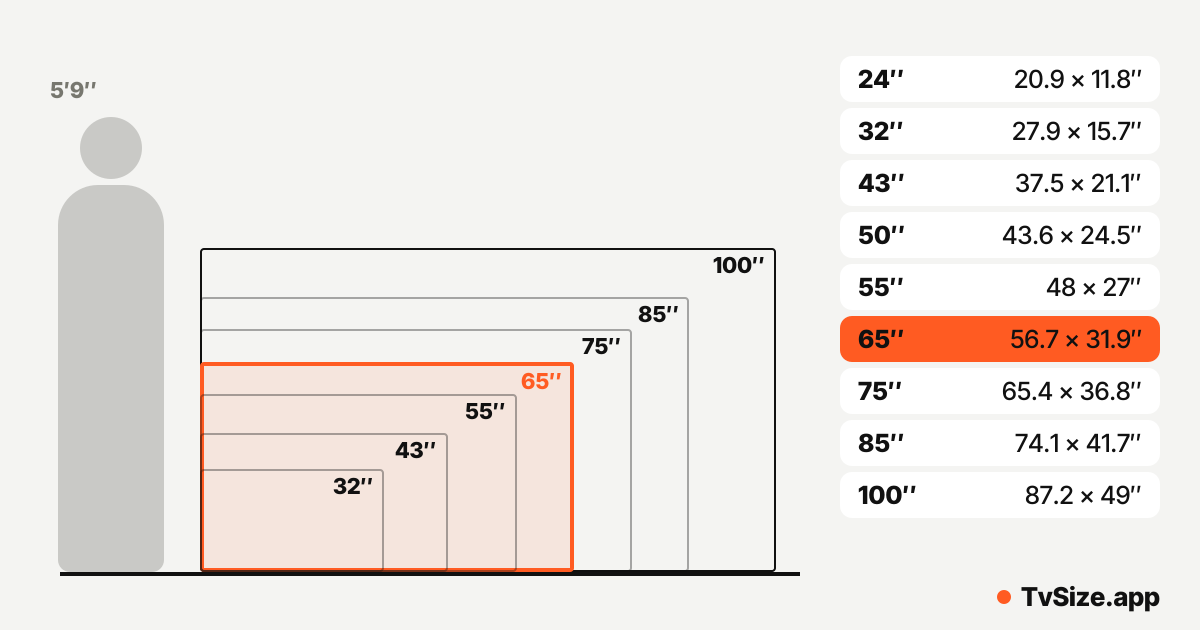
More on small TVs for the kitchen, bedroom and RVRoom size → TV size
TV size by viewing distance: chart
What size TV for 6, 8 or 10 feet away? For common viewing distances, the chart shows which sizes look balanced, which subtle and which cinematic.
| Distance | Subtle2.3–3 × | Balanced1.4–2.3 × | Cinematic1–1.4 × |
|---|---|---|---|
| 5 ft5 ft away | 24″ | 27–42″ | 43–60″ |
| 6 ft6 ft away | 24–27″ | 32–50″ | 55–70″ |
| 7 ft7 ft away | 32″ | 40–60″ | 65–83″ |
| 8 ft8 ft away | 32–40″ | 42–65″ | 70–90″ |
| 9 ft9 ft away | 40–45″ | 48–77″ | 80–100″ |
| 10 ft10 ft away | 40–50″ | 55–85″ | 86–100″ |
| 12 ft12 ft away | 48–60″ | 65–100″ | > 100″ |
| 14 ft14 ft away | 58–70″ | 75–100″ | > 100″ |
For 4K TVs. Balanced: distance = 1.4 to 2.3 × diagonal (about 35° to 21° viewing angle). Cinematic: 1 to 1.4 × (around the THX value of 1.2 ×). Subtle: 2.3 to 3 × (around Stiftung Warentest’s 2.5 ×).
How TV sizes are measured
A TV’s size in inches is the diagonal of its picture, from one corner of the screen to the opposite one. The bezel does not count.
- Inches and centimeters
- One inch is 2.54 cm, so a 55″ TV has a picture diagonal of 140 cm.
- Width and height
- In the 16:9 format the picture is about 0.87 × the diagonal wide and 0.49 × as tall: 48.0″ × 27.0″ at 55″.
- The TV itself
- With its bezel, a current 55″ TV measures about 48.4″ × 28.0″: barely wider than the picture, a little taller because of the bar below it. A stand adds more height.
- Measuring your own TV
- Measure the picture diagonally from corner to corner: in inches that is the size, in centimeters divide by 2.54. Hard to reach the corners? Measure the width of the picture: width ÷ 0.87 is the diagonal.
TV inches to cm converter
Enter a size in inches, or the diagonal, width or height in cm. The other values update automatically.
Closest size with all details: 65 inch
1 inch = 2.54 cm. Width and height are for the picture in the usual 16:9 format, without bezel. Inches to cm
TV size FAQ
What TV sizes are there?
Common sizes run from 24 to 100 inches. Smaller sets with 19 to 22 inches are still made for RVs and kitchens, and a few models go up to 115 or 116 inches.
What are the most popular TV sizes?
In living rooms, 55 and 65 inches are the most common sizes, and 75 inches and up are becoming more common. Bedrooms and smaller rooms often get 43 or 50 inches, kitchens 24 to 32 inches. Every brand offers its widest choice of models in these sizes.
How big is a 55, 65 or 75 inch TV?
Width × height of the picture: 55″: 48″ × 27″, 65″: 57″ × 32″, and 75″: 65″ × 37″. With the bezel the TV is slightly larger, mostly in height because of the bar below the picture.
What size TV should I get?
That depends on how far away you sit: the picture looks balanced at 1.4 to 2.3 times the screen diagonal. At 8 ft, that is 42–65″. Sit closer for a more cinematic picture, farther for a subtler one.
Is a TV measured diagonally, with or without the bezel?
Diagonally, from one corner of the picture to the opposite one, without the bezel. The TV itself is a little larger: a 55″ TV has a picture of 48.0″ × 27.0″ and measures about 48.4″ × 28.0″ with its bezel.
How much bigger is a 65-inch TV than a 55-inch?
Its picture is 8.7″ wider and 4.9″ taller, and its area grows by about 40%. The area grows with the square of the diagonal, so each step up looks bigger than the inch numbers suggest.
Are TV sizes the same for every brand?
For the picture, yes: a 65-inch TV has the same diagonal at every brand, and in 16:9 also the same width and height. Only the outer size differs a little, depending on bezel and stand: check the data sheet if space is tight.
What does “65-inch class” mean?
US stores sell TVs by size class. The visible picture is sometimes a little smaller than the class, for example a 64.5-inch diagonal on a “65-inch class” TV. Half an inch is hardly visible; the exact diagonal is in the data sheet.
What size TV fits in 46″ of width?
Up to a 50-inch TV: with bezel it is about 44″ wide. A 55-inch TV would already be too wide at about 48″. These are typical values of current models, so check the data sheet before buying. The width is for a niche or wall space. On furniture, allow about 4 in (10 cm) more, and the stand has to fit on it.
Which TV size fits your room?
Try any TV size to scale on a photo of your wall. Free, no sign-up.
Try it on your wall